
Learn Realistic Drawing: The 5 Skills That Make It Look Real
Realistic pencil drawing comes down to five learnable skills: value, light and shadow, edges, proportion and texture. Here's how to learn each one.
By Ayoub Farid · · 2 min read
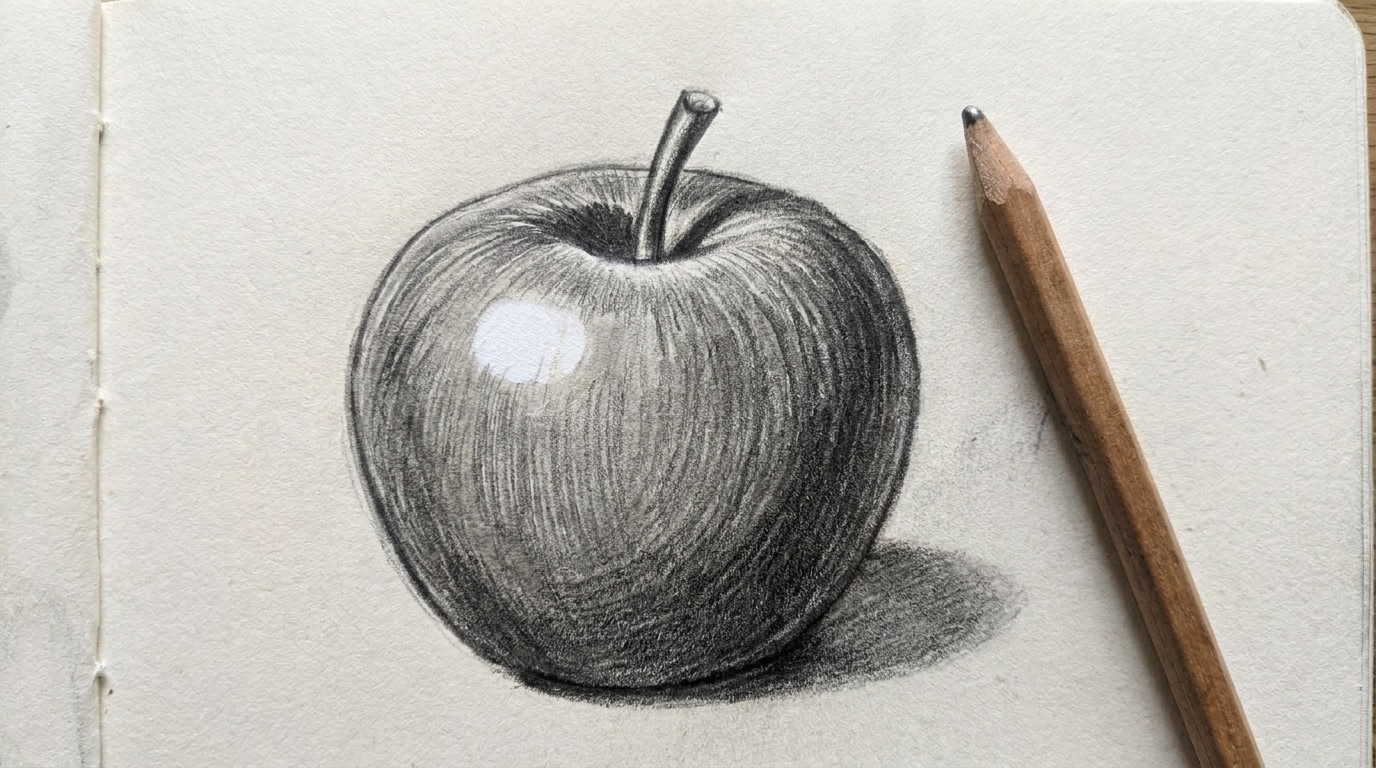
Why does one drawing of an apple look real and another look like a sticker? It's rarely about detail. It's about five skills. Learn these and almost anything you draw will start to look three-dimensional.
1. Value
Value is lightness and darkness. Realistic drawings use the full range: white paper, several greys and real darks. Most beginner drawings stay in the middle greys and look flat.
Practice: value scale, then push your darkest dark with a 4B or 6B.
2. Light and shadow
Every lit object follows the same pattern: highlight, light side, core shadow, reflected light, cast shadow. Get them in the right places and the object looks round.
Practice: shade a sphere and read light and shadow in drawing.
3. Edges
Edges facing the light are crisp; edges turning into shadow are soft; cast shadows soften as they move away. Hard outlines everywhere kill realism.
Practice: hard and soft edges.
4. Proportion
Shapes and spacing must match the subject. In an eye, the iris tucks under the upper lid; in a mug, the bottom ellipse matches the rim.
Practice: measuring proportions.
5. Texture
Texture is the last 10%: speckles on a lemon, the shine of a glass, the grain of wood. Add it after the form works, and less than you think.
Practice: drawing textures.
The order matters
Learn them in this order: value → light and shadow → edges → proportion → texture. Beginners often start with texture and detail (every eyelash, every hair) on a drawing with no light, and it never looks real.
Graphite's first track, Light & shadow, covers the first three on a value scale, a sphere and an apple. The Realistic eyes track adds proportion.
A four-week plan covering all five skills
Week one: value (value scales, gradients). Week two: light and shadow (spheres, eggs, cubes). Week three: edges and proportion (mugs, books, eye shapes). Week four: texture and a finished piece (an orange, a lemon, then a small still life). Repeat the cycle with harder subjects. Each pass makes the five skills more automatic.
Frequently asked questions
What is the most important skill for realistic drawing?
Value. If your lights and darks are right, a drawing reads as realistic even with little detail.
Do I need to draw from photos to draw realistically?
Photos are useful references, but drawing real objects under one lamp teaches you more about light. Do both. See drawing from reference.
Which pencils give the most realistic results?
A range: harder (HB, 2H) for light areas and softer (2B–6B) for darks. See pencil grades explained.