How to Measure Proportions in Drawing (Sight-Size Basics)
Get proportions right: measure with your pencil, compare widths and heights, use angles and tick marks, and check your drawing with simple tricks.
By Ayoub Farid · · 2 min read
A beautifully shaded drawing still looks wrong if the proportions are off: an eye that's too round, a mug that's too tall, boxes of different widths. The good news is that proportion isn't about a "good eye". It's about measuring.
Measure with your pencil
- Hold your pencil at arm's length, elbow locked, one eye closed.
- Line up the tip with one edge of the object and slide your thumb to the other edge.
- That's your unit. Compare it to other distances: "the mug is 1.5 units tall and 1 unit wide."
- Transfer the ratio (not the size) to your paper.
Keep your arm fully straight every time, or the measurements change.
Mark before you draw
Lightly mark key points with small tick marks: top, bottom, left, right, the widest point. Then connect them. It's much easier to adjust a tick mark than a finished outline.
Graphite's coach often suggests exactly this. In the value scale lesson, one real tip was: "Before drawing dividers, mark small light tick marks along the line to check box widths first."
Check angles
Hold your pencil vertically or horizontally against the object and judge the angle of an edge against it. Then copy that angle on paper.
Use the negative space
Look at the shapes around the object: the gap between a mug's handle and its body, the space between two cherries. Negative shapes are easier to see accurately because your brain doesn't "know" what they should look like.
Check your drawing
- Flip it. Look at it in a mirror or flip the photo. Errors jump out.
- Step back. Look from a few meters away.
- Turn it upside down. You see shapes instead of symbols.
Proportion example: the eye
| Common mistake | Correct proportion |
|---|---|
| Iris fully visible | Upper lid covers the top of the iris |
| Upper and lower lid curves the same | Upper lid curves more; its highest point is a bit toward the inner corner |
| Almond perfectly symmetrical | Tear duct on the inner corner, outer corner slightly different |
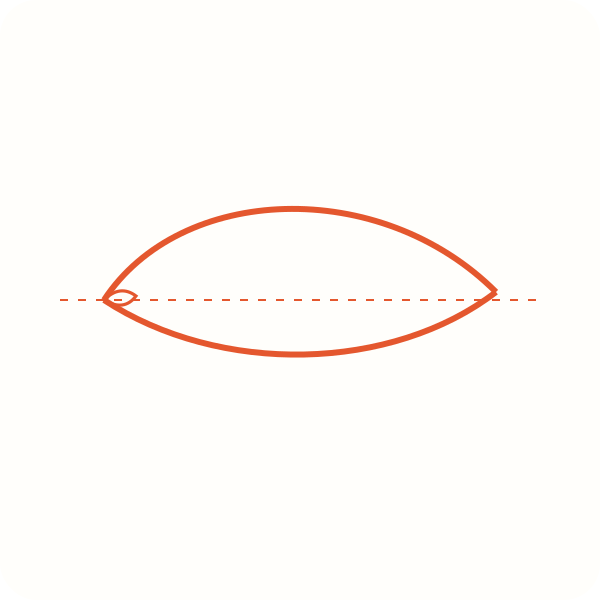
Full guide: how to draw an eye.
Frequently asked questions
Why are my drawings always too big or too small on the page?
Mark the top and bottom of the object on the paper before you start, so the drawing fits.
Is it cheating to measure?
No. Measuring is how artists have always worked. With practice, your eye starts doing it automatically.
What's the difference between proportion and perspective?
Proportion is the relationship between sizes. Perspective is how those sizes change with distance and angle. See one-point perspective.