
One-Point Perspective Drawing for Beginners
Learn one-point perspective: horizon line, vanishing point and how to draw boxes, books and rooms that look 3D. Simple steps with beginner tips.
By Ayoub Farid · · 2 min read
Perspective is how objects look smaller and edges converge as they move away from you. One-point perspective is the simplest system, and it's enough to draw boxes, books, roads and rooms that look convincingly 3D.
The two key parts
- Horizon line: a horizontal line at your eye level.
- Vanishing point: a point on the horizon where all lines going straight away from you meet.
Draw a box in one-point perspective
- Draw a horizon line and a vanishing point (VP) in the middle.
- Draw a square below the horizon. This is the front face.
- From each corner, draw light lines to the VP.
- Decide how deep the box is and draw a smaller square's back edges parallel to the front, between those lines.
- Erase the lines behind the box. Shade: top lightest, sides darker (how to draw a cube).
What eye level changes
- Box below the horizon: you see its top.
- Box on the horizon: you see only the front.
- Box above the horizon: you see its bottom.
Where one-point works
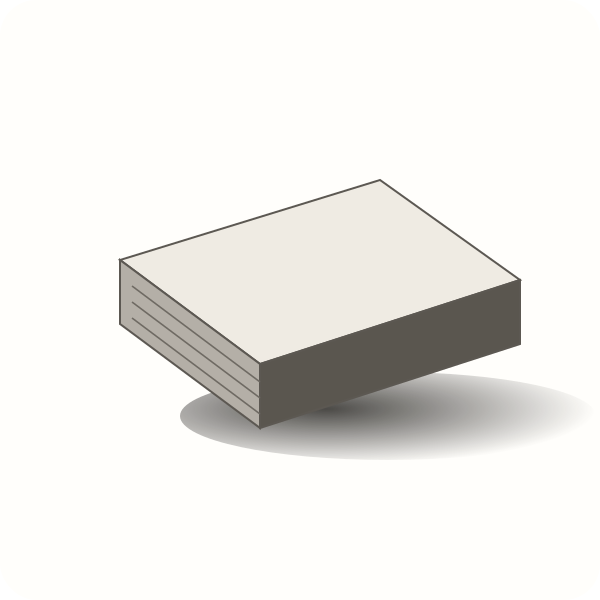
Objects facing you squarely: a book on a table seen straight on, a hallway, train tracks, a road. When an object is turned at an angle, you need two-point perspective (two vanishing points).
Simple perspective tips for still life
You don't always need vanishing points. For small objects:
- Keep parallel edges leaning the same way.
- Make ellipses (tops of cups) flatter near eye level and rounder below.
- Things further away are smaller and higher on the page.
A 15-minute perspective drill
- Draw a horizon line and one vanishing point.
- Draw five boxes: one above the horizon, one on it, three below at different distances.
- Shade each with light from the top left.
- Add a cast shadow to each box on the ground.
You'll see how eye level changes what you see, and how shading works the same at any angle.
Once boxes feel easy, try a simple hallway or a road disappearing into the distance, using the same single vanishing point.
Frequently asked questions
Do I need perspective to draw realistically?
For still lifes of small objects, a basic sense of it is enough. For rooms, buildings and landscapes, yes.
What's the difference between one- and two-point perspective?
One-point: the object faces you, one set of lines converges. Two-point: the object is turned, two sets converge to two points.
Should I use a ruler for perspective?
For practice exercises, yes; it helps you understand the system. Later, freehand.