
How to Draw a Cube and Shade It (3 Values)
Draw a 3D cube showing three faces, keep parallel edges consistent, and shade it with three clear values: light top, medium side, dark side, plus its shadow.
By Ayoub Farid · · 2 min read
The cube teaches the opposite of the sphere: instead of smooth gradients, flat planes with distinct values. It's also a first taste of perspective.
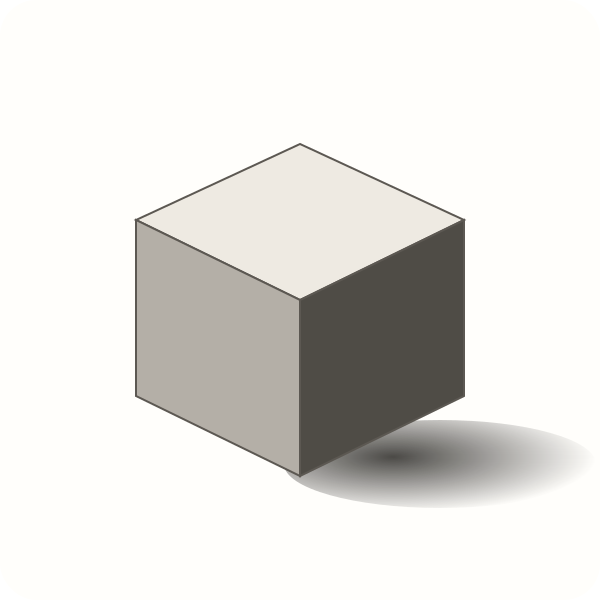
Step 1: The top face
Draw the top as a diamond (a rhombus): wider than it is tall.
Step 2: Vertical edges
From the three nearest corners, draw vertical lines down, all the same length (or the middle one slightly longer).
Step 3: Bottom edges
Connect the bottoms. Keep each bottom edge parallel to the matching top edge.
Parallel edges should lean the same way. This one rule fixes most wonky cubes.
Step 4: Three values
With light from the top left (Graphite's daily sketch instruction):
- Top: lightest
- Left side: medium
- Right side: darkest
"Three clear values make it look solid."
Step 5: Shadow
Add a cast shadow to the lower right, darkest where the cube touches the table. The shadow's edges follow the cube's bottom edges.
Refinements
- Slightly lighten the shadow side near the bottom (reflected light).
- Keep the edges between planes crisp (hard and soft edges).
- For more realism, draw in perspective.
Value plan
| Face | Value with light from the top left |
|---|---|
| Top | 1–2 (lightest) |
| Left side | 3 (medium) |
| Right side | 4–5 (dark) |
| Cast shadow at the base | 5 (darkest) |
Use your value scale as a reference: each face should match one box.
Practice variations
- Cube from below: draw the cube above your eye level so you see its underside instead of its top.
- Light from the right: swap the left and right values. It's a quick way to check you understand the rule rather than memorizing it.
- Rounded cube (a sugar cube or eraser): keep the same three planes, but soften the edges where they meet into narrow gradients.
- Two cubes: place one slightly in front of the other so it casts a shadow onto the second.
Troubleshooting
- Top looks like it's tilting toward you: the back edges aren't parallel to the front ones.
- Cube looks transparent: you drew the hidden back edges darkly. Keep construction lines light and erase them.
- Sides look smudgy: shade each face separately and keep the shared edges crisp.
Frequently asked questions
Why does my cube look flat?
The three faces are too similar in value. Make them clearly different.
Do cubes have a core shadow?
No. Flat planes change value at the edges; there's no gradual turn.
What objects are cubes?
Boxes, books, dice, buildings. See how to draw a book.