
Light and Shadow in Drawing: The 5 Elements of Shading
Understand light and shadow in drawing: highlight, mid-tone, core shadow, reflected light and cast shadow, with examples and how to place each one.
By Ayoub Farid · · 2 min read
Light behaves the same way on every object. Once you know the pattern, you can shade an egg, an eye or a mug without guessing. Artists usually describe it as five elements.
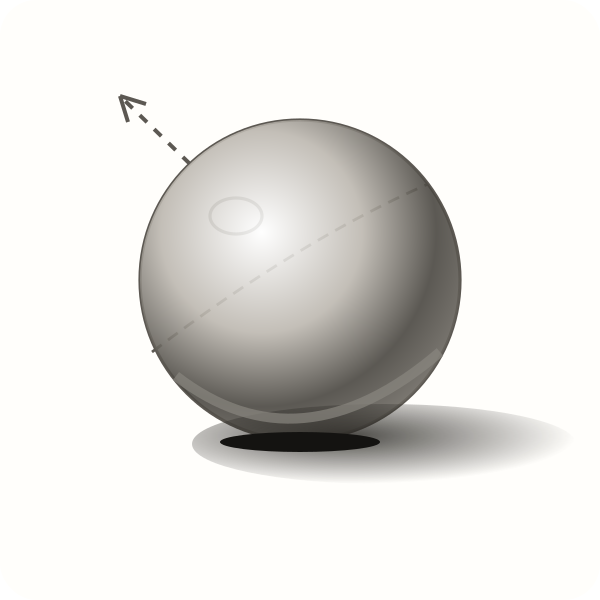
The five elements
1. Highlight
The brightest spot, where light hits the surface most directly. On shiny objects it's small and sharp; on matte objects, broad and soft. In pencil, it's usually untouched white paper. (Highlights)
2. Light side (mid-tone)
The area facing the light, a bit darker than the highlight. It gradually darkens as the surface turns away.
3. Core shadow
The darkest band on the object, where the surface turns away from the light. On a sphere it's a curved band inside the shadow side, not on the edge. (Core shadow)
4. Reflected light
A slightly lighter area inside the shadow, near the edge, caused by light bouncing off nearby surfaces like the table. It's always darker than the light side. (Reflected light)
5. Cast shadow
The shadow the object throws onto other surfaces. It's darkest and sharpest where the object touches the surface (the "occlusion" or contact shadow) and gets lighter and softer further away. (Cast shadow)
Form shadow vs cast shadow
The shadow side of the object is the form shadow. The shadow on the table is the cast shadow. They behave differently: form shadows have soft edges on round objects; cast shadows have a shape that depends on the object and the surface. (Form shadow vs cast shadow)
Rules that always apply
- One light direction for the whole drawing.
- Shadows fall on the side away from the light.
- The terminator (where light turns into shadow) follows the form: curved on a sphere, straight on a cube.
- Reflected light never gets as bright as the light side.
- Cast shadows are darkest at the contact point.
Try it on simple forms
| Form | How light behaves |
|---|---|
| Sphere | Smooth gradient, curved core shadow |
| Cube | Flat planes, one value per plane |
| Cylinder | Vertical bands, core shadow near one side |
| Cone | Bands narrowing toward the tip |
Frequently asked questions
What's the difference between a shadow and a shade?
In drawing, "shade" often means the form shadow on the object, and "shadow" the cast shadow. People use the words loosely; the five elements are clearer.
Do flat objects have a core shadow?
No. Flat planes change value abruptly at edges. Core shadows appear on curved forms.
How do I practice light and shadow?
Shade a sphere under a desk lamp, then an egg. Graphite's Light & shadow track takes you through these step by step.