
Core Shadow: Where the Darkest Shadow on an Object Goes
What a core shadow is, why it sits inside the edge on round objects, how to find it on spheres, cylinders and faces, and how to shade it in pencil.
By Ayoub Farid · · 2 min read
The core shadow is the darkest band on an object, where its surface turns away from the light. Placing it correctly is the single biggest jump from "flat circle" to "round ball".
Where it is
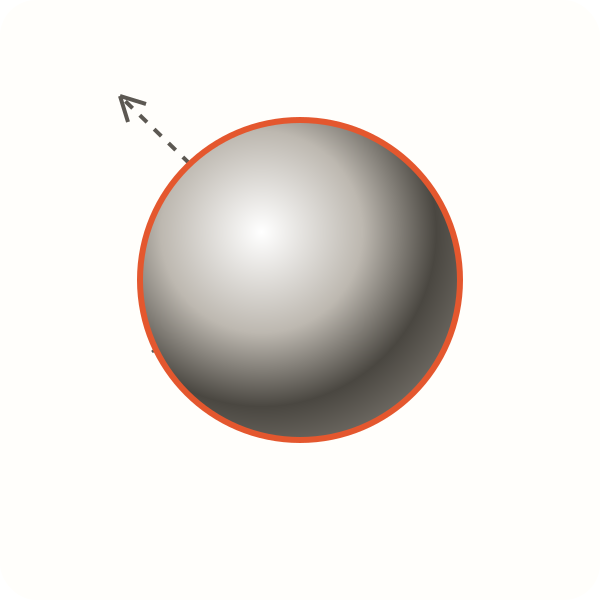
On a round object, the core shadow sits just inside the shadow side, a little away from the edge. Between the core shadow and the edge, the surface catches light bouncing off the table (reflected light), so it's slightly lighter.
The most common beginner mistake
Beginners often put the darkest tone right on the outline, like a dark ring around the shadow side. This makes the object look like a flat disc with a dark border.
Fix: leave a slightly lighter band between the core shadow and the edge.
How to find the core shadow
- Locate the terminator: the line where light turns into shadow. On a sphere lit from the top left, it's a curve across the lower right.
- The core shadow starts just past the terminator, in the shadow side.
- It's darkest there, then lightens slightly toward the edge.
On different forms
| Form | Core shadow shape |
|---|---|
| Sphere / egg | Curved band, following the form |
| Cylinder / can | Vertical band, a little in from the shadow-side edge |
| Cone | Band that narrows toward the tip |
| Cube | No core shadow (flat planes change value at edges) |
Graphite's tip for cans and candles says it simply: "Cylinders are darkest in a band just before the right edge. The right edge is a little lighter than that band."
How to shade it
- Lay down the whole shadow side in a light tone.
- Darken the core band with a softer pencil, in layers.
- Soften the transition toward the light side (the terminator on a round form is soft).
- Leave the edge a touch lighter for reflected light.
Practice: shade a sphere, a can and an egg under one lamp, and compare the shape of the core shadow on each.
Frequently asked questions
Is the core shadow the darkest part of the drawing?
Often the darkest part on the object. The cast shadow right where the object touches the table is usually even darker.
Does every object have a core shadow?
Every curved object lit by a directional light does. Flat-sided objects don't.
How wide should the core shadow be?
Fairly narrow on a sphere under a single strong light; broader and softer under diffuse light.
Related: light and shadow in drawing, reflected light, how to shade a sphere.