
How to Draw a Lemon in Pencil (Shape, Shading and Texture)
Draw a realistic lemon lying on its side: an oval with a point at each end, shading that follows the form, a few dots for the peel and a cast shadow.
By Ayoub Farid · · 2 min read
A lemon is an egg's cousin with two pointy ends and a bumpy skin. Graphite's daily sketch: draw a lemon on its side, an oval with a small point at each end. Shade it with light from the top left, and add its shadow.
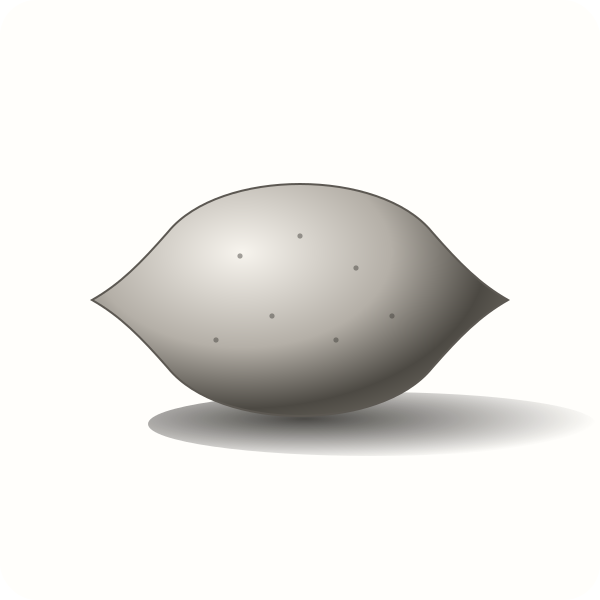
Step 1: The oval
Draw a horizontal oval, slightly fuller on one side.
Step 2: The tips
Add a small nub at each end. One end (the stem end) is usually smaller and flatter.
Step 3: Shading
Light from the top left:
- Follow the oval with your pencil strokes.
- Brightest area: upper left, broad and soft.
- Core shadow: a soft band along the lower right, inside the edge.
- The tips get a little shadow underneath.
Step 4: Texture
A few tiny dots suggest the skin. Don't overdo them: concentrate dots in the mid-tones and leave the highlight and deep shadow mostly clean. (Textures)
Step 5: Cast shadow
A long oval shadow to the lower right, darkest under the lemon.
Tips
- Lemons are semi-glossy: the highlight is softer than an apple's but sharper than an egg's.
- Keep the outline light.
Value plan
| Area | Value |
|---|---|
| Broad highlight | 1 |
| Light side | 2 |
| Core shadow (lower right) | 4 |
| Reflected light near the bottom edge | 3 |
| Under the tips | 4 |
| Contact shadow | 5 |
A 10-minute practice plan
- 2 min: oval and tips, very lightly.
- 5 min: shade with strokes that follow the oval, building the core shadow.
- 2 min: a few dots in the mid-tones.
- 1 min: cast shadow.
Variations
- A lemon standing on one tip: the oval becomes more circular; good foreshortening practice.
- A lemon slice: a flat circle with segments radiating from the center and a thin rind ring, lit softly.
- A lemon next to an egg: compare a semi-gloss surface with a matte one.
Troubleshooting
- Looks like an egg: exaggerate the tips slightly and add the skin texture.
- Looks bumpy everywhere: remove texture from the highlight and the deepest shadow.
Try drawing a lemon and an egg side by side to feel the difference between a semi-gloss and a matte surface.
Frequently asked questions
How do I make a lemon look different from an egg?
The pointed tips, the slightly uneven oval and the dotted skin texture.
Should I stipple the whole lemon?
No. A few dots in the mid-tones read as texture; stippling everything looks like sandpaper.