Contour Drawing: Exercises to Train Your Eye
What contour drawing is, how blind and modified contour exercises train observation, and how to use contour lines in realistic pencil drawings.
By Ayoub Farid · · 2 min read
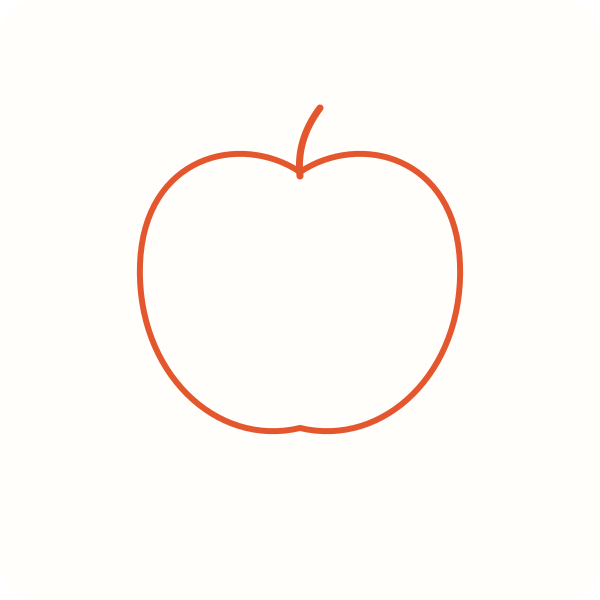
Contour drawing is drawing the edges of things: the outline of an apple, the folds of a sleeve, the curve of a lid. It sounds simple, but done slowly it's one of the best exercises for learning to really look.
Types of contour drawing
Blind contour
Look only at the object, never at the paper. Move your pencil slowly as your eyes trace the edge. The result looks strange, but that's not the point: you're training eye-hand coordination and attention.
Modified contour
Look mostly at the object, glancing at the paper occasionally to check placement. Results look more accurate and still train observation.
Cross-contour
Lines that wrap around the form, like lines of latitude on a globe. They show the 3D shape and help you plan shading direction. See how to shade a sphere.
How to do a blind contour exercise
- Pick something with interesting edges: your hand, a crumpled paper, a shoe.
- Put your pencil on the paper and your eyes on the object.
- Imagine the pencil is touching the edge. Move slowly, matching your eye speed.
- Draw for 3–5 minutes without looking down.
Contour lines in realistic drawing
In finished realistic drawings, strong outlines often make objects look flat. Real objects don't have lines around them; they have edges where one value meets another.
- Draw contours lightly as a guide.
- Let shading define the edge in the finished drawing.
- Keep edges crisp in light and soft in shadow (hard and soft edges).
Why it helps beginners
- Breaks the habit of drawing symbols ("an apple is a circle with a stem") instead of what you see.
- Builds patience and slows you down.
- Improves proportion, because you follow the actual edge.
A contour progression
Week one: blind contours of your hand, five minutes a day. Week two: modified contours of kitchen objects. Week three: cross-contour lines on a sphere, an egg and a banana, to see how lines can describe form. Week four: a realistic drawing where you start with a light modified contour and finish with shading only, erasing the contour where it's not needed.
Frequently asked questions
Is blind contour drawing useful or just a warm-up?
Both. It's a warm-up that trains the habit of looking more than drawing, which improves everything else.
Should my final drawings have outlines?
Light ones are fine. Avoid dark, even outlines around everything; they flatten the form.
How often should I do contour exercises?
A few minutes, a couple of times a week, as part of your warm-up.