How to Practice Drawing Effectively (Deliberate Practice)
Practice drawing deliberately: set one clear goal per session, get fast feedback, repeat with one fix, stay at the edge of your ability and review weekly.
By Ayoub Farid · · 2 min read
Two people can both draw for an hour a day and improve at very different speeds. The difference is how they practice. "Deliberate practice", a structured way to train skills, applies perfectly to drawing.
The five parts of deliberate practice
1. A clear, specific goal
Not "get better at drawing" but "place the core shadow inside the edge of a sphere."
2. Just beyond your comfort zone
Too easy and you don't learn. Too hard and you get frustrated. Pick tasks you can do with effort.
3. Fast feedback
Know quickly whether you hit the goal: self-check, a teacher, or a coach. (Feedback)
4. Repetition with adjustment
Repeat the task, fixing one thing each time.
5. Focus
Short, focused sessions beat long distracted ones. Put the phone away (except for your reference or coach).
A deliberate practice session (20 min)
- Goal (1 min): "Today: cast shadows that are darkest at the contact point."
- Attempt (6 min): draw an egg with a cast shadow.
- Feedback (2 min): check against the goal.
- Second attempt (6 min): fix the main issue.
- Compare (2 min): what changed?
- Note (1 min): write the next goal.
Structure your learning path
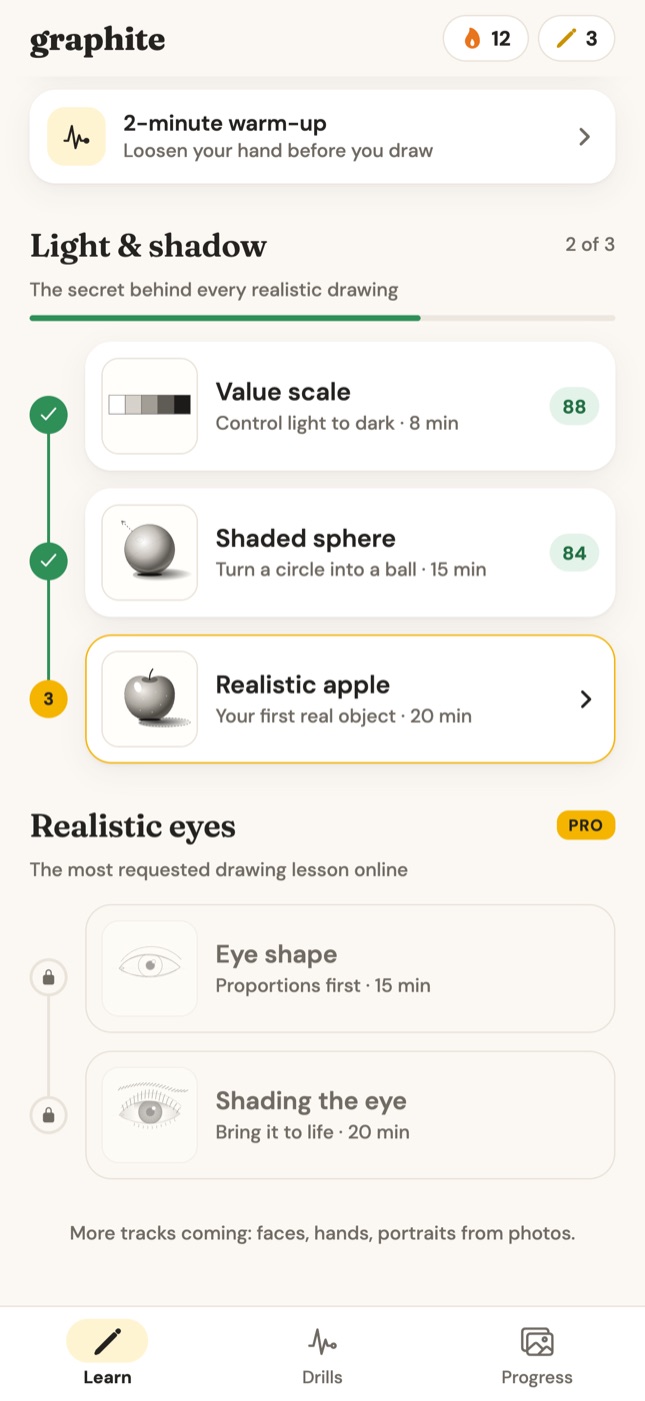
Practice works best when goals build on each other: values before spheres, spheres before apples, apples before eyes. A learning path keeps you from jumping ahead. (Roadmap)
Common practice traps
- Drawing only what you're already good at.
- Never finishing or never repeating.
- No feedback.
- Copying lines without understanding why.
How Graphite structures practice
Each lesson step is a clear goal with a short instruction and tips. After each step you get feedback (a score, what's working, up to two fixes) and can retake immediately. The coach also ignores things you haven't learned yet, so each attempt stays focused on one goal.
Signs your practice is working
You need fewer attempts to pass the same exercise. Your mistakes change: instead of the core shadow on the edge, you're now fixing subtle edges. You spot problems in your drawing before anyone tells you. And when you compare drawings a month apart, the difference is obvious. If none of this is happening after a few weeks, make your goals smaller and your feedback more frequent.
Frequently asked questions
Is drawing every day enough to improve?
It helps, but deliberate practice with clear goals and feedback improves you much faster than just drawing every day.
How long should a practice session be?
15–30 minutes of focus is plenty for most beginners.
Should practice be fun?
Mix it: some focused exercises, some free drawing for fun. Both keep you going.